
New vs. Used Equipment Financing: What Actually Changes (and What Doesn't)
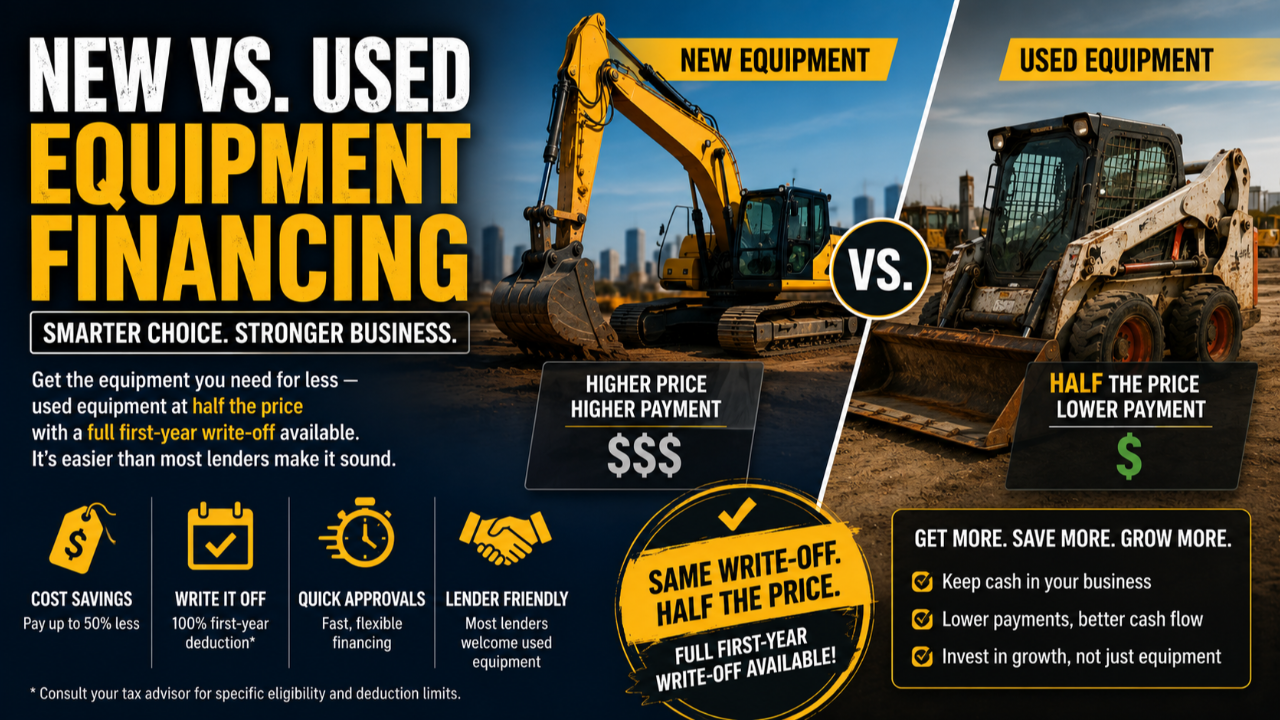
There's a belief among business owners that used equipment is hard to finance. That lenders want shiny things, that a machine with hours on it is a problem, that if you want financing you'd better be buying new.
It's mostly wrong. And it's expensive to believe, because used equipment is frequently the better buy — a low-hour used excavator can run 40–60% of the cost of new, and it will do the same work.
Here's what actually changes when you finance used, what doesn't, and how to tell which one is right for your situation.
Start with what doesn't change: the tax treatment
This is the part that surprises people most, so let's put it up front.
Used equipment qualifies for the full first-year write-off. Both Section 179 and 100% bonus depreciation apply to pre-owned assets. The requirement for bonus depreciation isn't that the equipment is factory-new — it's that it's new to your business. First use by you, not first use ever.
So a five-year-old machine you buy at auction for $180,000 gets the same first-year deduction treatment as a $400,000 new one. You just deducted less money, because you spent less money — and you're running comparable capacity.
That's worth sitting with. The tax code is completely indifferent to whether someone else owned the machine first. A lot of business owners assume otherwise and pay a six-figure premium for a benefit they already had.
(As always: confirm with your CPA. State conformity varies and the taxable income limitation on Section 179 is real.)
What does change: five things, honestly
Used financing isn't identical to new. It's just not the wall people imagine. Here's the actual difference:
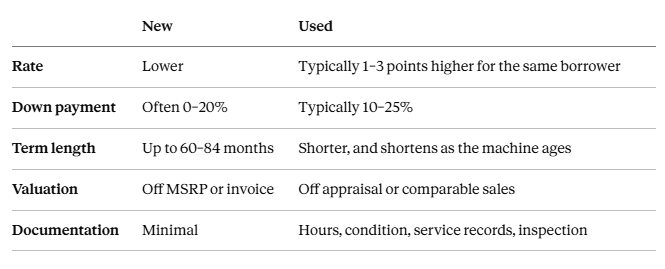
1. A modest rate premium. Used loans generally run 1–3 percentage points above comparable new financing for the same borrower profile. That reflects depreciation risk and reduced collateral certainty. It's real, and it's usually swamped by the purchase price difference — which is the point most rate-focused comparisons miss.
2. More down. Lenders use the down payment to manage loan-to-value on an asset that's already partway down its depreciation curve. Strong borrowers with late-model equipment sometimes still get low or no money down; weaker credit or older assets typically means 10–25%.
3. Shorter terms. This is the one that actually bites, and it's covered below.
4. Valuation instead of a price tag. New equipment has an invoice. Used equipment has a market. The lender wants to know what it's genuinely worth — which usually means auction comps, and sometimes an independent inspection or appraisal on larger deals.
5. Paperwork about the machine, not just about you. Hours or mileage, maintenance records, inspection reports, the purchase agreement. Have these ready and a used deal moves nearly as fast as a new one. Show up without them and it drags.
The rule nobody explains: age plus term
Here's the mechanic that quietly kills more used deals than anything else, and almost no one tells you about it in advance.
Lenders don't underwrite the equipment's age today. They underwrite its age at loan maturity.
Banks typically cap financed equipment at roughly 7–10 years old at the end of the term. Run that backward. If a bank is writing a 5-year note, that machine can't be more than about 3–5 years old on the day you buy it. Not because there's anything wrong with a 9-year-old dozer — but because the arithmetic of their policy won't allow it.
This is why owners get confused. They're told "we finance used equipment," they bring in a solid 10-year-old machine that inspects clean, and they get declined. Nothing was wrong with the asset. They just ran into a formula.
Equipment finance specialists work differently. Independent finance companies routinely fund 12–15-year-old machines — high-hour excavators, rebuilt trucks, older production equipment — when the machine inspects well and the price lines up with auction comparables. The trade for age is usually a bigger down payment and a shorter term. Not a decline.
If a bank turned you down on equipment age alone, that's one of the most placeable declines in this business. It's a policy problem, not a credit problem.
The depreciation argument for buying used
New equipment takes its steepest depreciation hit in the first two or three years. Someone has to absorb that. The only question is whether it's you.
Buying a two-to-four-year-old machine means the previous owner ate the worst of the curve while you get most of the useful life. The asset you're financing sits on a flatter part of its value line, which means you build equity faster relative to what you paid and you're less likely to be underwater midway through the term.
For assets with strong secondary markets — trucks, trailers, earthmoving equipment, standard shop machinery — this is often the single best value in the market. Active resale markets also finance at better rates than custom or niche equipment, because the collateral is genuinely liquid.
When new is actually the right call
We'd rather you make the right decision than the one that closes fastest. New wins when:
- Uptime is existential. If one machine going down stops your revenue entirely, a factory warranty is worth real money. Buy the warranty.
- The technology genuinely moved. Sometimes newer isn't cosmetic — efficiency, emissions compliance, automation, or a capability the older generation simply doesn't have.
- You're keeping it 10+ years. Amortized over a long enough hold, the new premium thins out considerably.
- You want the longest term and lowest payment. Longer terms are available on new equipment, and if monthly cash flow is the binding constraint, that matters more than total cost.
- Support and parts availability. Orphaned equipment with no dealer network is a headache regardless of what you paid.
The honest framing: match the equipment's expected remaining life to your financing term, and be truthful with yourself about whether your business can absorb an unplanned repair. That's the whole decision.
Buying from a private seller
Dealer purchases are straightforward. Private sales are where people get stuck — but they're very doable if you know what's coming:
- Title and lien verification. The lender will confirm the seller actually owns it free and clear. This is for your protection as much as theirs.
- Third-party inspection is likely on anything substantial.
- The lender pays the seller directly. Money doesn't route through you. Set expectations with the seller early — some get spooked by this and shouldn't.
- Expect more down than on a comparable dealer deal.
Plan for an extra few days. That's the whole cost.
Don't finance a problem
Cheap equipment that doesn't run isn't cheap. Before you sign:
- Get an independent inspection. Pay for it. It's the best money in the transaction.
- Pull maintenance records. A machine with a documented service history is a fundamentally different asset than one without.
- Check hours or mileage against the price using real auction comps, not the seller's optimism.
- Confirm parts and support availability for the model.
- On big-ticket items, get a third-party appraisal.
A lender who wants an inspection isn't creating friction. They're doing the diligence you'd want done anyway, and they're doing it on their dime as much as yours.
The bottom line
Roughly eight in ten U.S. businesses finance equipment rather than paying cash for it. Buying used is how a large share of them stretch that capital further.
Used equipment costs less, qualifies for the same first-year write-off, and finances at a premium that's usually a rounding error against the price gap. The genuine constraints are age-plus-term policy, a bigger down payment, and documentation about the machine. Those are all workable — with the right lender.
Everlasting Capital finances new and used equipment from $1,000 to $2,000,000 — machinery, commercial vehicles, technology, shop equipment, medical and dental — across all 48 continental states, with terms up to 60 months, deferred payment options, and up to 100% financing that can include shipping, taxes, and installation.
If a bank declined your deal because of the machine's age, bring it to us. That's a conversation, not a dead end.
Apply in minutes at everlastingcapital.com/apply
Everlasting Capital is not a tax advisor and this article is not tax advice; consult a qualified tax professional about Section 179 and bonus depreciation as they apply to your business. Rate, term, down payment, and equipment age ranges cited reflect general market conditions and vary by lender, program, credit profile, and asset type. Financing terms, amounts, and approval times vary.
