
Why Banks Keep Saying No — and Where the Money Actually Is
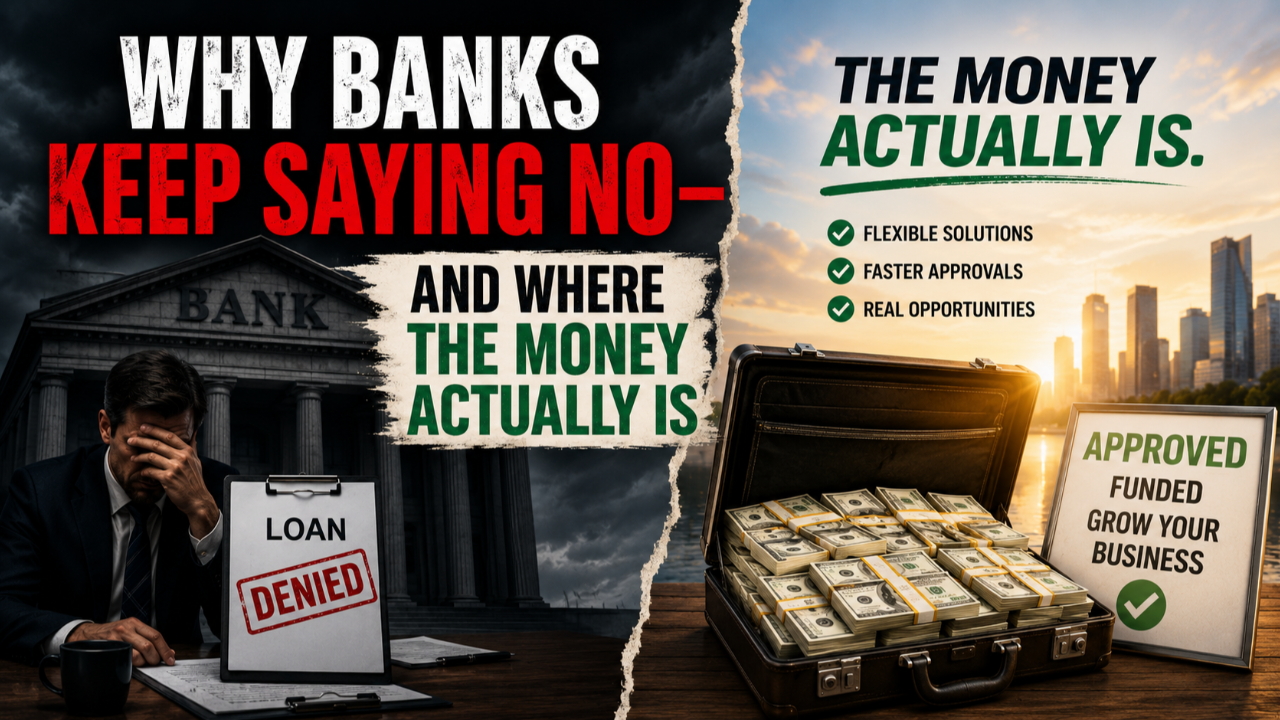
You put together the package. Two years of returns, the P&L, the bank statements, the projections. You sat across from someone who nodded a lot. Then you waited three weeks and got a letter with one paragraph in it.
No explanation you could actually use. No counteroffer. Just no.
Here's what almost nobody tells you in that moment: it probably wasn't about you.
The numbers say this is structural
The Federal Reserve surveys tens of thousands of small businesses every year about their financing experiences. The 2025 Small Business Credit Survey, released in 2026, is the clearest picture available of what's actually happening — and it's not a picture of a market where good businesses get funded and bad ones don't.
Of the small businesses that applied for financing:
- 42% received the full amount they asked for.
- 22% received nothing at all.
- The rest got partial funding — approved, but not for what they needed.
For context on how far the ground has shifted: in 2019, roughly 62% of applicants got full approval. The share fully approved has remained below pre-pandemic levels ever since.
Now break it down by who they applied to. Large banks fully approved around 40% of applicants. Small and community banks did meaningfully better at 57%. Same businesses, same economy — the outcome depended substantially on which door they walked through.
That's not a story about creditworthiness. That's a story about institutional appetite.
Why banks say no (the real reasons)
Denial letters are vague by design. Here's what's usually underneath them:
1. Small loans cost banks the same as big ones. Underwriting a $75,000 equipment loan takes nearly the same work as underwriting a $2 million one. The revenue doesn't come close to matching. Banks have quietly optimized toward larger deals for fifteen years, and small-ticket lending is where they've pulled back hardest.
2. Their box is narrower than you think. Banks underwrite to a template: years in business, debt service coverage ratio, credit score floors, industry codes they'll touch and ones they won't. Miss one criterion — one — and the file gets declined regardless of how strong everything else looks. There's often no human with the authority to say "yes, but."
3. Your existing debt counts against you. The Fed has tracked elevated debt levels playing an increasing role in denials. If you took on debt in the last few years — like most businesses did — it's now sitting in your file working against your next application, even if it's performing perfectly.
4. Credit score is doing too much work. Among businesses denied or only partially funded, a low credit score was the single most commonly cited reason, at 45%. Note what that means: score-driven decisions, on a metric that reflects your past rather than the asset you're buying or the contract you just signed.
5. Regulatory pressure runs one direction. Post-2008 capital requirements made small business lending structurally less attractive on bank balance sheets. That pullback started in 2009 and has continued straight through into 2026. Nobody at your branch decided this. It was decided several pay grades above them, years ago.
None of these have anything to do with whether your business is good. They're about whether your business fits a model that was built for someone else.
The 2 million businesses that never even ask
Here's the statistic that should bother everyone in this industry.
The Federal Reserve estimates that more than 2 million U.S. businesses every year have a real financing need and simply don't apply — because they assume they'll be rejected. They're called discouraged borrowers.
Think about the compounding cost of that. Contracts not bid. Trucks not bought. Hires not made. Not because capital was unavailable, but because one bad experience taught an owner that capital was unavailable to them, and they never tested it again.
If a bank turned you down in 2023 and you've been operating on that assumption since, you're working from stale information about a market that has changed substantially.
Where the money actually is
The honest map of the landscape in 2026, tradeoffs included:
Small and community banks. The best full-approval rate of any bank category at 57%, and borrower satisfaction runs high — around 68%. Slow, relationship-driven, and worth a conversation if you have one nearby and time to spare. Not useful when you need an answer this week.
CDFIs. Mission-driven, patient, the highest borrower satisfaction of any channel at roughly 72%. Excellent terms if you fit their profile and geography. Limited capacity and often long queues.
SBA loans. Real money moving here — SBA lending hit a record $45.1 billion in FY2025, up nearly 45% year over year. Genuinely good rates. The tradeoff is process: paperwork, personal guarantees, and timelines measured in months. Great for a planned expansion, useless for a machine that died Tuesday.
Online and fintech lenders. This is where the migration is happening — the share of applicants going to fintech lenders climbed from 17% in 2020 to 29% in 2025. Speed and approval rates are the draw. But the Fed also found that high interest rates and unfavorable repayment terms were the most commonly reported challenges among businesses that used online lenders. That's worth saying plainly, even coming from us: speed has a price, and some of this market prices it badly.
Equipment financing specifically. Structurally different from all of the above, for one reason.
Why equipment financing sits outside the problem
Every category above is underwriting you. Equipment financing underwrites the asset.
The equipment secures the loan. That single fact changes the analysis. A lender isn't betting solely on your credit history — there's a machine or a truck with a known market value standing behind the deal. That's why equipment financing approves profiles that banks reject on sight: newer businesses, owners with credit damage from a bad stretch, industries banks have decided to avoid wholesale.
It also means the conversation is about something concrete. Not "does this business fit our model," but "what is this asset, what's it worth, and what will it earn."
What to do differently
Stop treating one denial as a verdict. It's one institution's template, on one day. It's not a credit rating and it's not a judgment on your business.
Ask which door you're knocking on. The 40% versus 57% full-approval gap between large banks and small banks is real, and it exists before anyone looks at your file.
Match the product to the need. SBA for the planned expansion. Community bank for the long relationship. Equipment financing for the asset that has to be running by next month. Using the wrong instrument is a common and expensive mistake.
Read the terms, not the headline. The Fed's own data says unfavorable terms are the top complaint against online lenders. Ask for the total cost, the payment schedule, and the prepayment terms in writing. Any lender who won't put it in writing is telling you something.
Apply. Whatever else you take from this: don't be one of the two million.
Where we fit
Everlasting Capital was built in 2012 for exactly the businesses this system keeps missing — the ones with a real need, a real asset to finance, and a file that doesn't fit somebody's template.
Bad credit, no credit, great credit, brand new business: it's a conversation, not a scoring exercise. We finance new and used equipment from $1,000 to $2,000,000 across all 48 continental states, with terms up to 60 months, deferred payment options, and up to 100% financing that can cover shipping, taxes, and installation.
Applications take minutes. Approvals frequently come back within hours. Funding can follow in as little as 24 hours.
We won't be right for every situation, and we'll tell you when we're not. But you'll get an actual answer, and you'll get it fast enough to be useful.
Find out where you stand at everlastingcapital.com/apply
It costs nothing to ask. It has cost a lot of businesses to assume.
Statistics cited from the Federal Reserve's 2025 Small Business Credit Survey (released 2026), the SBA Office of Advocacy, and SBA lending reports. Financing terms, amounts, and approval times vary by program, credit profile, and equipment type.
